

In this guide, we’ll go over what is high ticket closing, and then dive into how you can optimize your sales strategy with new closing techniques to close more high-value deals.
What is High Ticket Closing?
High ticket closing is the complex sales process focused on selling high-priced products or services.
The difference between the traditional selling approach and high ticket selling is that the process of closing high-value deals requires a deeper understanding of your client’s needs.
The characteristics of a high ticket deal include high-priced products or services (usually over $1,000 in value), longer sales cycles, and a tailored solution that takes into account your client’s unique needs.
As high ticket deals involve multiple stakeholders, a longer sales cycle (can take months to reach a decision), and many alternatives lurking in the background, the average sales close rate in 2024 was 29%.
➡️ Later in this guide we will cover enterprise sales techniques that you can use to close more high ticket deals for your organization.
Examples of High Ticket Closing
Now that we went over what high ticket closing is and its characteristics, let’s explore a few examples from the B2B industry:
Closing B2B Software
Closing B2B software is when sales teams have to win 5, 6 or even 7-figure deals for their SaaS solution.
For example, HubSpot offers different plans that range from $15/month/seat up to more than $3,600 a month.
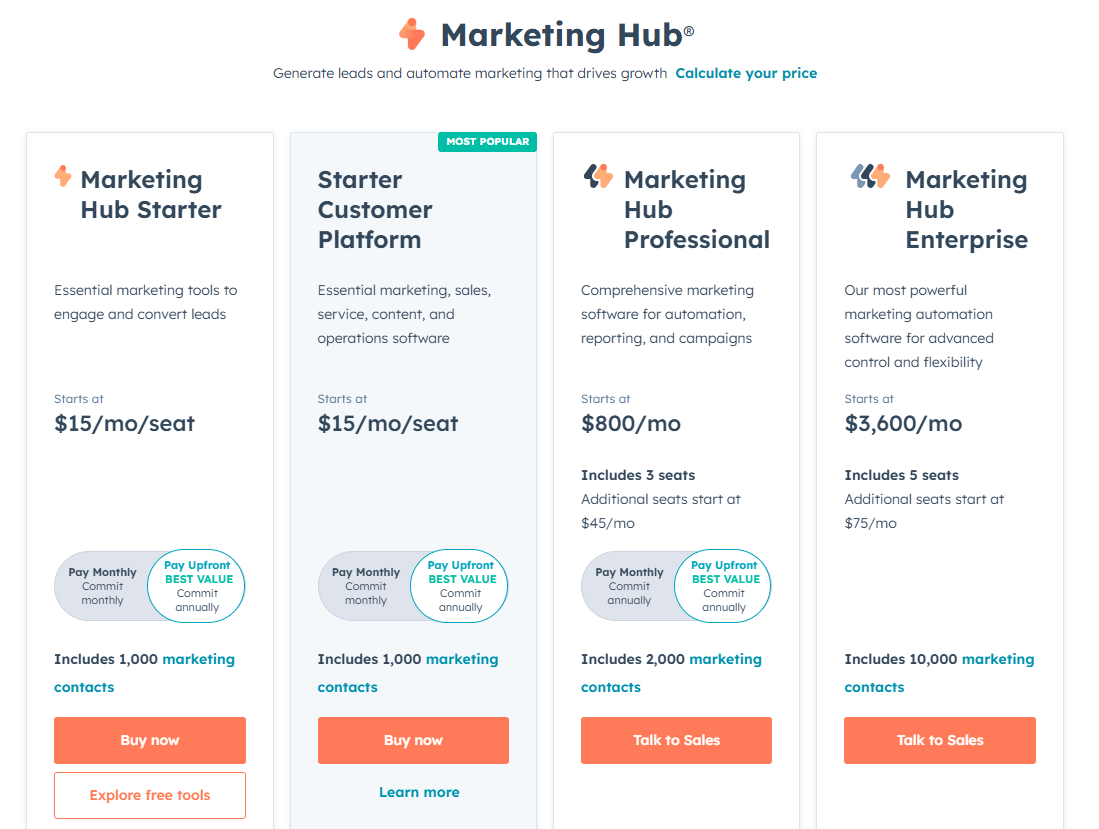
➡️ If you look at their pricing plans, you will notice that their sales team is not focusing on their ‘’Starter’’ plans, as they can be purchased right away.
But if you choose to be on their Professional or Enterprise plans, this is when you need to talk to their sales team.
This is because the sales team will provide you with a tailored pricing model that works for your business needs, team size, and required functionality.
On the other hand, their $15/month/seat plan has limited customization capabilities and there’s no access to personalized onboarding and customer success manager.
Closing Consulting Services
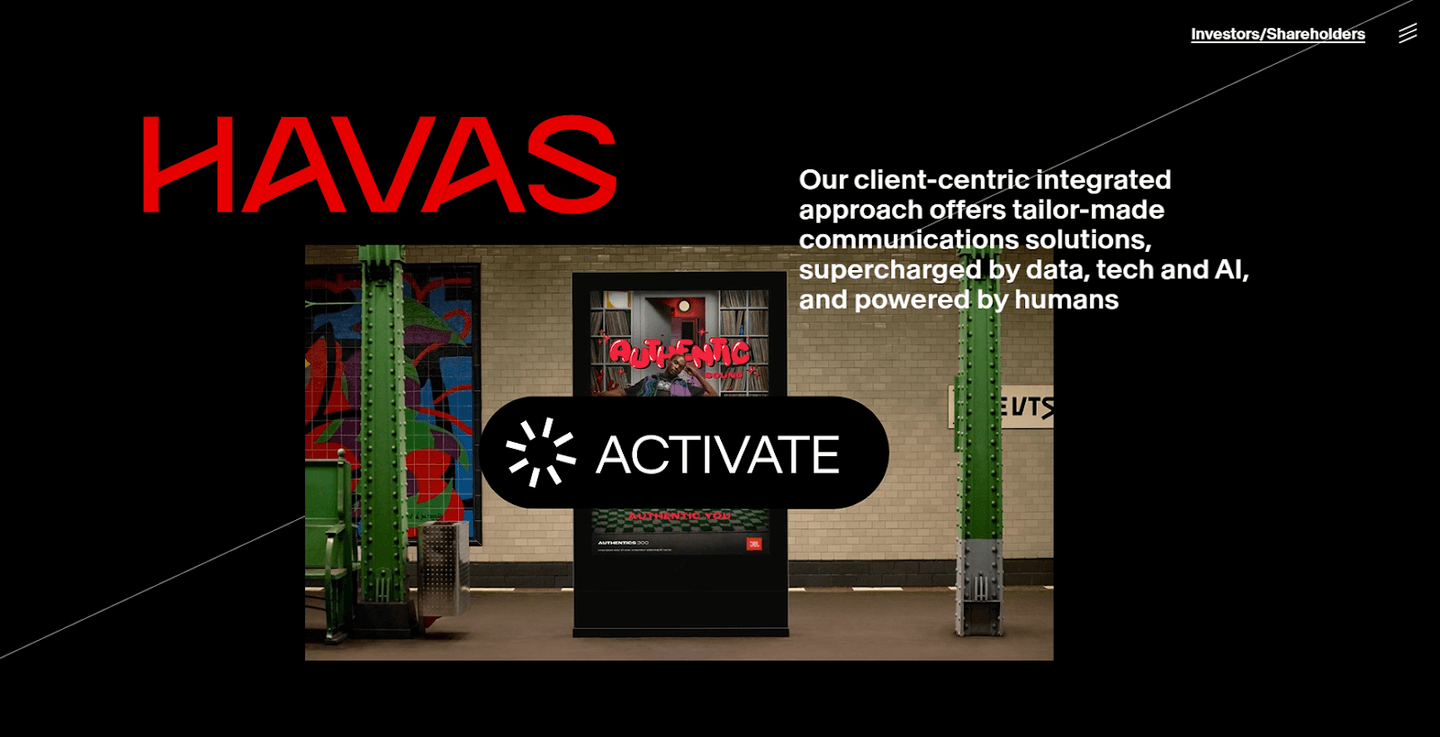
Have you noticed that consulting companies and marketing agencies like Havas do not feature a pricing model on their websites?
This is because they have a dedicated sales team that is working on proposing personalized offers.
The way it works with these consulting companies is that they’d propose your organization a ‘’scope’’ that will feature what they will provide you as a service.
The reason why closing consulting services is complex is because of the competition.
Sales teams inside consulting firms need to compete with other consulting firms, as clients would often speak to multiple agencies before committing to one.
Closing Business Coaching
Business coaching is another B2B service that does not disclose its pricing publicly.
Companies like CoachHub offer high-impact coaching for business leaders that enables them to deal with strategic dilemmas, collect unbiased feedback, and navigate change and uncertainty.
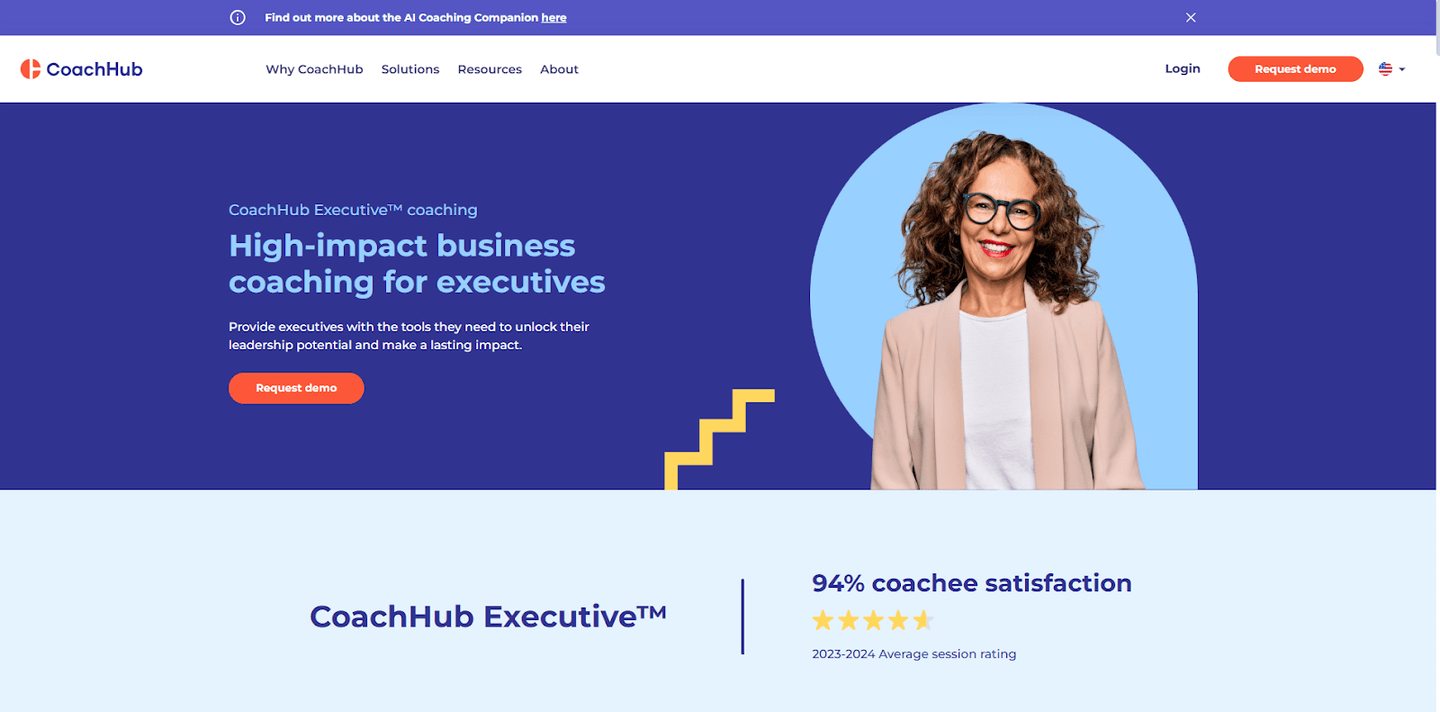
Closing the idea of business coaching is similar to closing consulting services – it’s hard to guarantee results.
Tips On Getting Better At High Ticket Closing
In this section, we’ll go over 9 tips to help you get better at closing high-value deals for your company.
We sourced our tips from some of the best high ticket sales experts, alongside our own sales team: 👇
#1: Give every high ticket deal a gameplan
A high ticket deal can look fine until legal or procurement shows up two weeks before the close date. Your best rep keeps a plan for their top few deals in their head and sees that coming. The rest get improvised.
Write the plan down for every deal: who signs, who can block it (security, legal, procurement), what the buyer said they need, the close date the buyer agreed to, and the next step on both sides. Share the dates and next steps with your champion, so both sides work to the same timeline.
Arrows (that’s us) keeps that plan on every deal. It reads every call transcript, email, and CRM note, builds a gameplan from your team’s playbook, and does the work between calls without anyone writing a prompt:
- Call prep before every meeting, including the first call with a new stakeholder.
- Follow-up emails drafted from what the buyer said on the call.
- Multi-threading, with research on everyone who signs off or can block the deal, so legal and procurement aren’t a surprise at the end.
- Date tracking for every date the buyer mentions.
Your reps approve each piece of work before Arrows sends it.
#2: Build Relationships, Not Just Transactions
One of the differences between closing high ticket sales and low-ticket is that you will need to build relationships (rapport) with your clients.
Instead of treating your customers as just transactions and handing them the bill, sales leaders like Charlie Perendes claim that sales reps should connect with their customers on a deeper level.
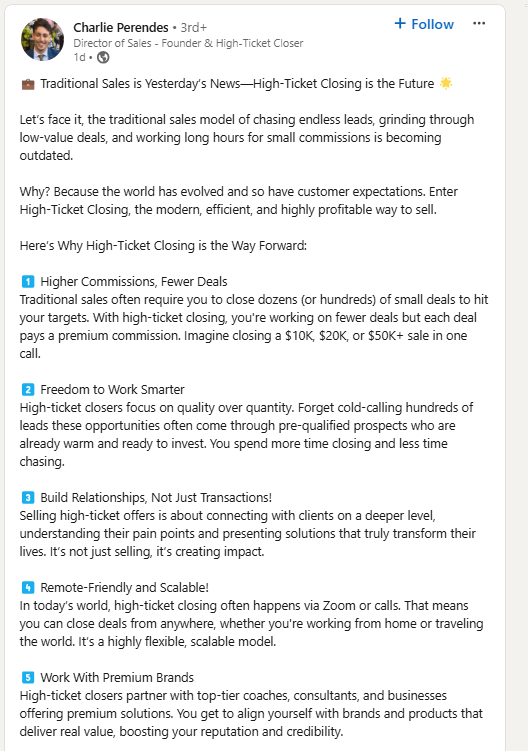
To close more high-value deals, sales development representatives should understand customers’ pain points and present them with solutions that can change their lives.
In our guide with B2B sales tips, we covered that a good way to build better relationships with your customers is by actively listening to them, understanding their pain points and (ideally) meeting in person.
#3: Leverage Social Proof
When trying to sign customers to pay thousands of dollars for your products or services, you will need to showcase relevant results.
For example, advertising agencies like Havas are displaying case studies on their website of their work with multinational companies across the world.
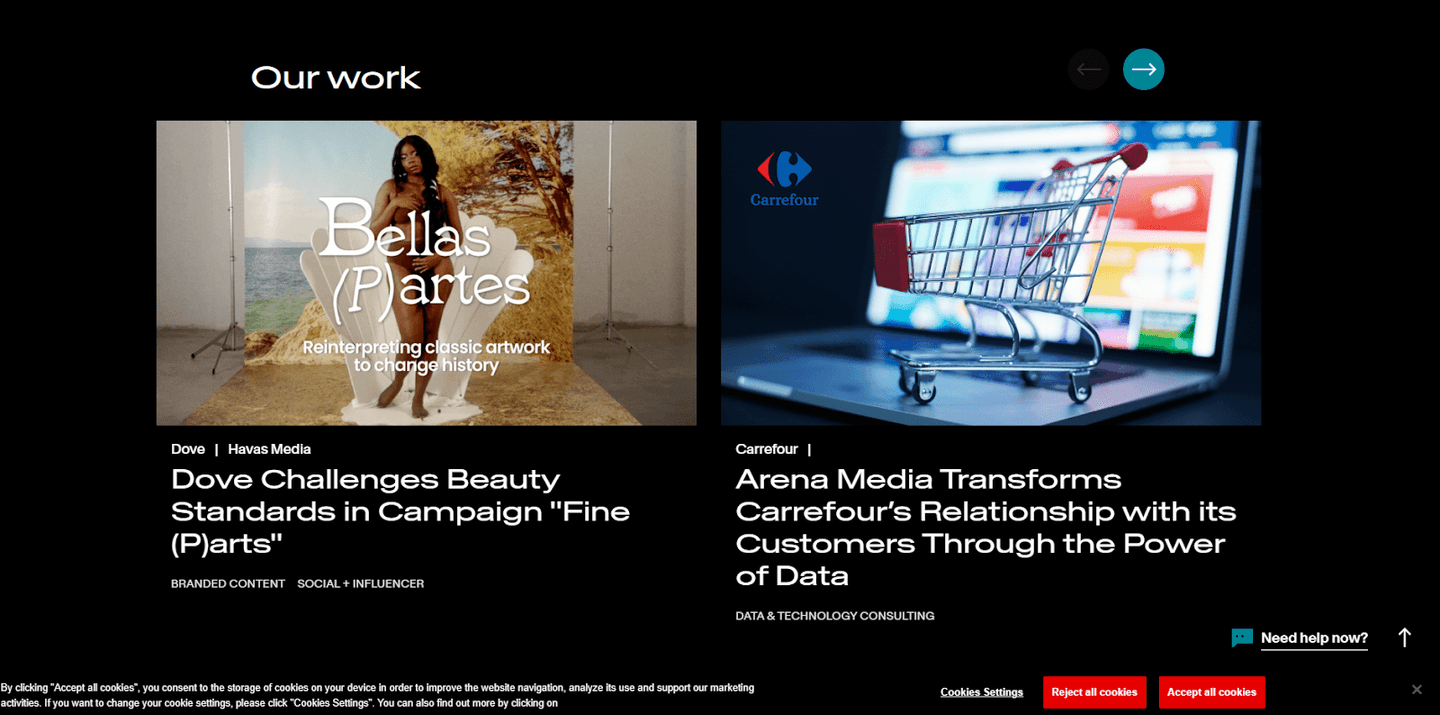
Social proof can be in the form of:
- Case studies of successful work that your product or service has produced that have specific numbers (e.g., 210% return on investment).
- Testimonials of happy clients.
- Reviews on trustworthy platforms, like G2, Capterra, and Trustpilot.
The more relevant the case studies and testimonials to the prospect’s industry and vertical, the better.
➡️ If the buyer raised a concern on the call, answer it in your follow-up with one case study from a company like theirs.
#4: Get Better At Following Up
Every sales professional knows the value of following up with their leads, but how many of us are doing it right?
In its Sales Mastery series, sales leader Sabri Suby goes over to explain the value of having a dedicated follow-up strategy that establishes a relationship with your prospects.
Sabri follows up like a ‘’madman’’ and argues that even if your prospects are shopping for other alternatives, it’s still worth it to follow up with them every 2 or 3 days to stay top of mind.
According to him, sales reps are going to lose 9 out of 10 high ticket deals if they are not following up on prospects hard enough.
💡 Research from Invesp found that 80% of successful sales take five or more follow-up calls.
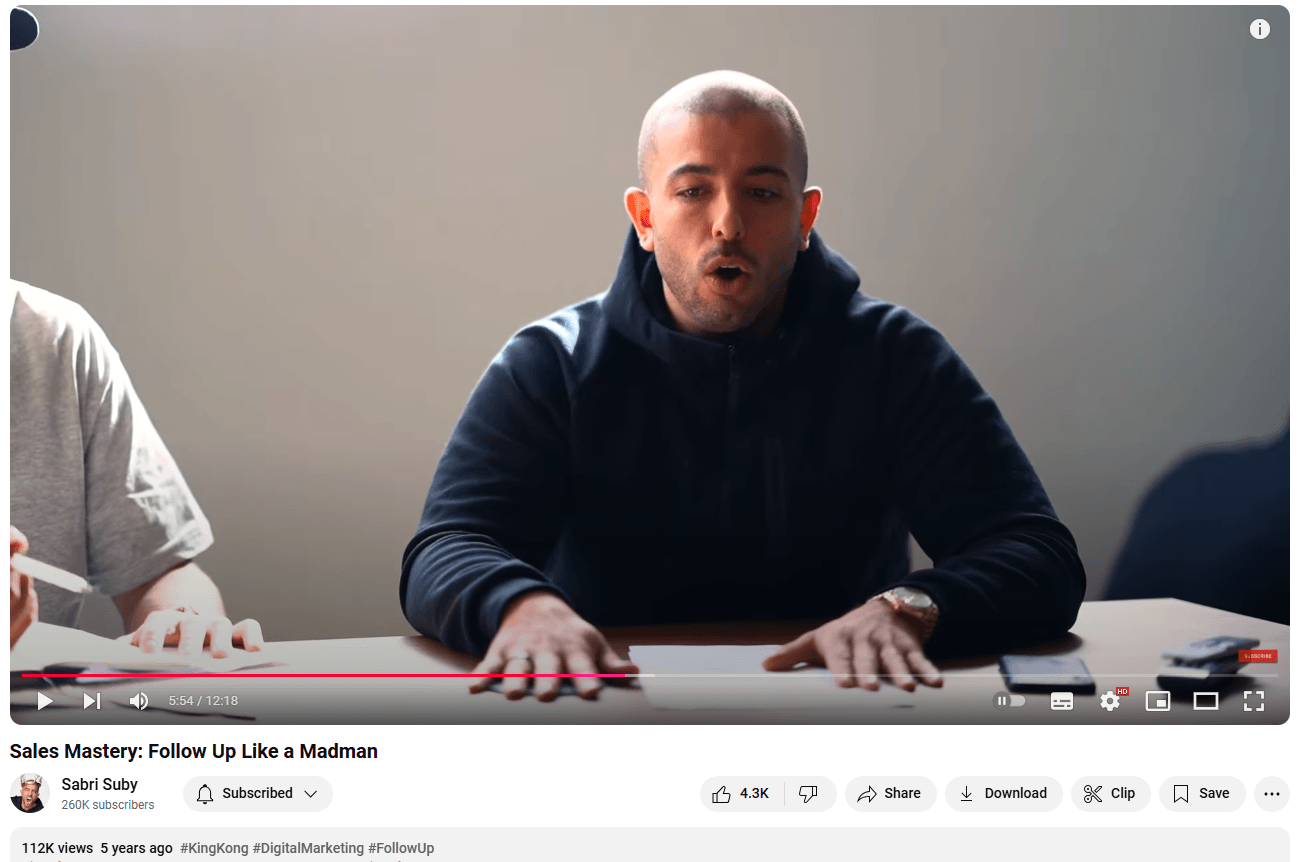
The sales expert then goes on to explain that companies can replicate that follow-up formula across the entire organization so every sales rep can become more effective in closing deals.
#5: Be Prepared To Handle Any Objection
No matter how good your product or service is, how amazing your case studies are, or even how irresistible your offer is, you will face objections sooner or later.
Sales experts like Chris Orlob recommend a framework for successful objection handling of any sort:
- Speaking calmly with authority, instead of interrupting the customer and appearing nervous.
- Clarifying the objections with questions so as not to address the wrong issue, such as asking the customer to help you understand what’s causing the concern.
- Validating the objection so that your customers feel heard and understood, and not judged.
- Offering a solution to that objection that reframes the problem into an opportunity or reframes the bad timing into good timing.
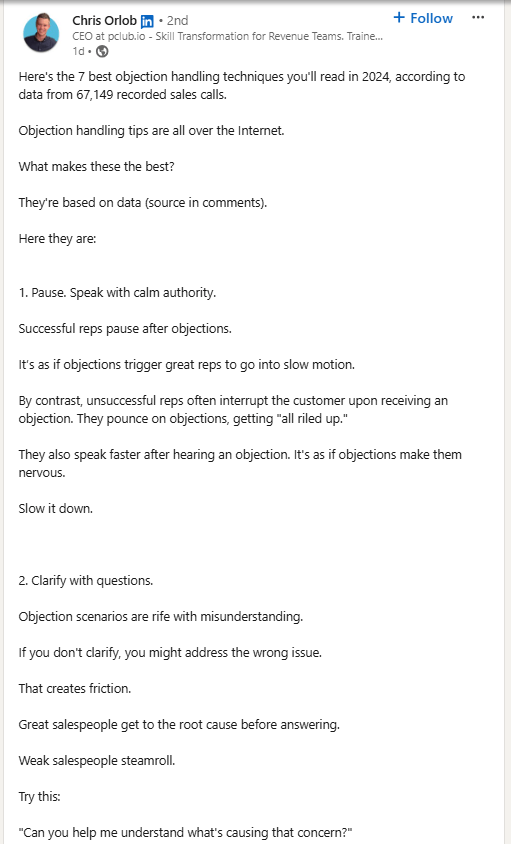
This formula will help you become more composed during objection handling and will let you uncover if the objection was a smokescreen (i.e., the lead never intended to buy) or a real concern.
#6: Sell The Value & Not The Features (Or Hours)
Closing high ticket products and services includes learning how to sell the value/results that you will bring to your clients.
Instead of talking about how amazing your product’s features are or how many hours your agency is going to be working on the project, you need to focus on what your clients will get as a result of using your solution.
In his post on how to sell high ticket SEO services, John Ozuysal explains that one of the mistakes that founders make is charging hourly rates instead of charging by value.
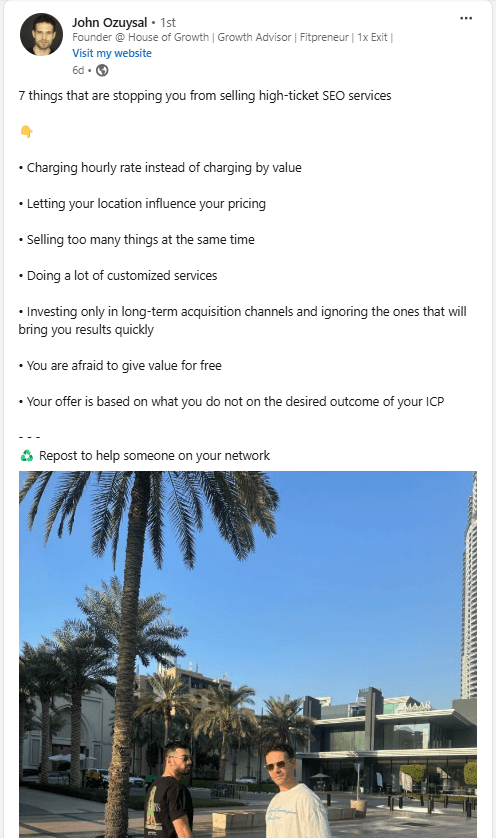
You will also notice that expert coaches are pricing their training on the value that their clients will receive, instead of on a per-hour basis.
#7: Coach Your Customers On The Opportunities Of Using Your Solution
When you’re trying to close B2B clients, you will need to be prepared to showcase the expertise of how your services or product can exploit opportunities or fix problems.
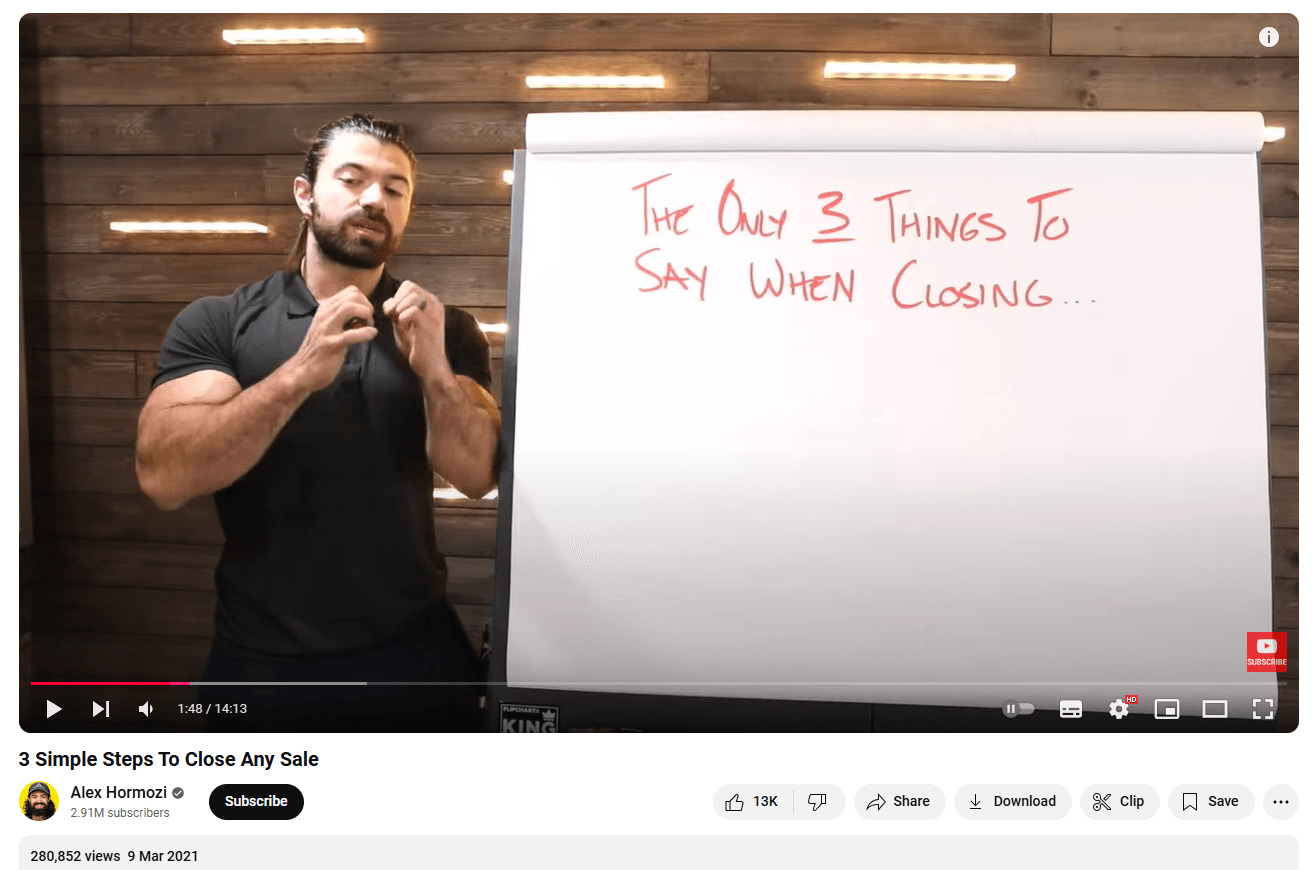
This is one of the tips that Alex Hormozi gives in his guide on how to close any sale, where he covers that being an expert in your own product and service is a must.
And then, you want to coach your prospects about the solution you’re proposing to them.
Naturally, it is the salespeople and not the developers doing the closing, which means that you will need to spend time learning as much as possible about:
- Your product and how it can solve various problems for your customers.
- How your product or service can exploit opportunities for growth or money saving.
- The whole process of changing the way they work and how that will affect their brand in the long run for good.
#8: Leverage Scarcity
Using scarcity is when you are nudging your leads to decide if they want to buy or not because your product or service cannot wait long enough.
This ‘’limitation’’ can be in the form of:
- Limited seats to your business coaching program.
- An offer that is expiring soon.
- Limited amount of clients that you are taking for a certain quarter.
Sales leaders like Marley Jaxx recommend using scarcity when trying to close high ticket deals by using urgency in the form of limited deals or bonuses to make up their minds quickly.
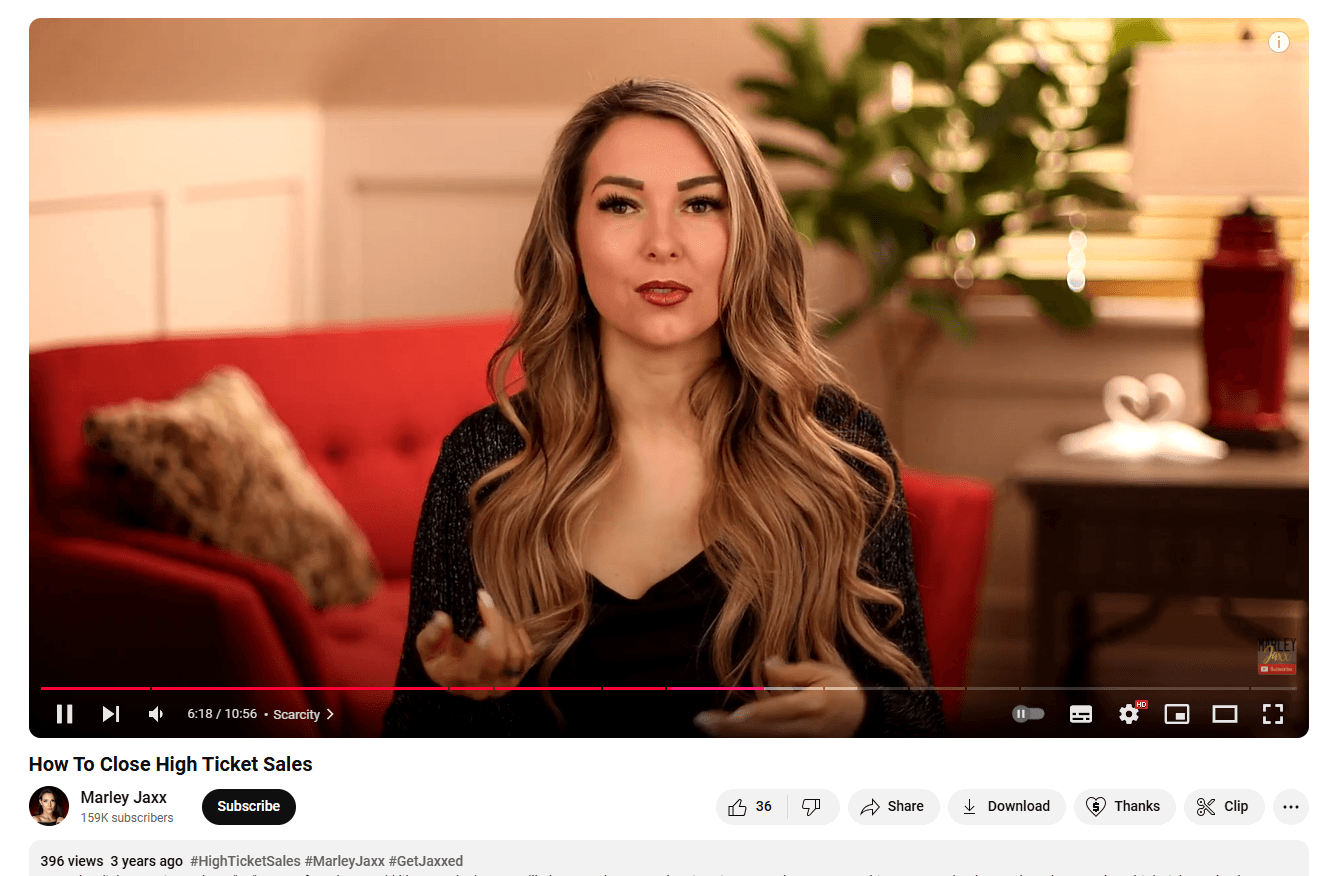
➡️ Marley warns that it’s not recommended to fake urgency (e.g., you mention that a deal ends tomorrow but it never ends) because that might ruin your reputation in the long run.
#9: Track Your Performance To Reflect
Last but not least, you and your sales team will get better at high ticket closing in the long run if you are tracking all aspects of your performance.
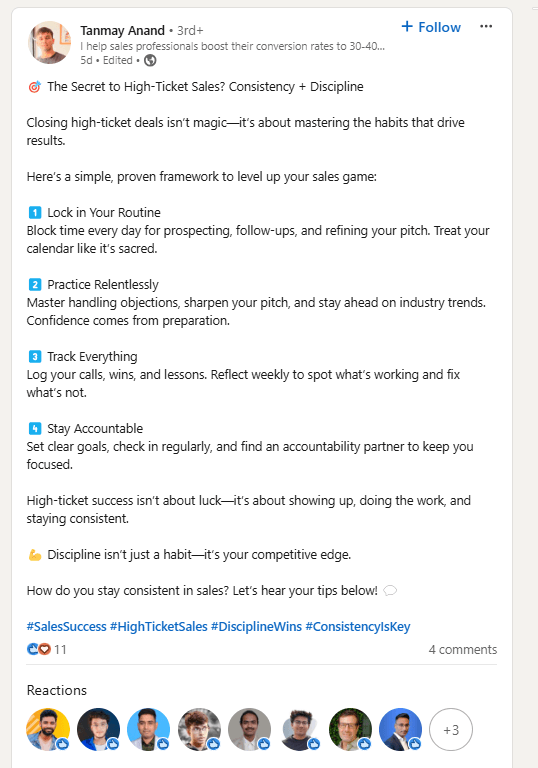
Tanmay Anand, a sales coach, recommends tracking not only won versus lost deals but also:
- Logging your calls.
- Logging your wins and lessons learned.
- Reflecting weekly on what is working and what is not with your clients.
💡 Sales planning software like Gong lets you record, transcribe, and analyze your interactions with clients at scale to identify patterns and get insights on why you are losing or winning deals.
What Are The Most Critical Skills For Successful High Ticket Closing?
Now that we went over actionable tips on how to close more high-value deals, we also need to go through what skills you need to develop to become more efficient: 👇
#1: Listening
As we went through the importance of building relationships with your clients and handling objections, active listening should be your number one priority to improve on.
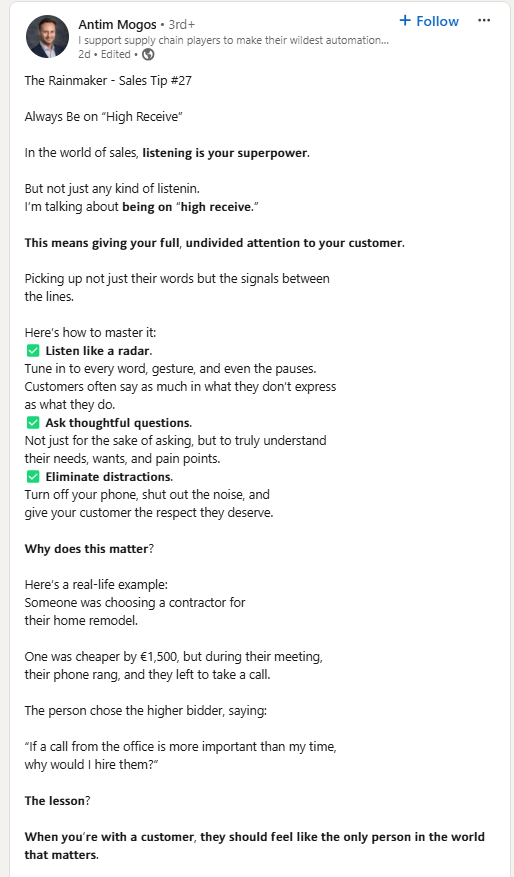
Antim Mogos recommends sales development representatives to be ‘’on high receive’’ by listening closely to what their customers are saying.
The sales expert gives a few tips on how you can do that:
- Listening to your customers like a radar by analyzing every word, gesture, and pauses in the speech that they are making.
- Asking thoughtful questions to better understand their needs, wants, and their pain points.
- Providing prospects with your full attention by turning off your phone, shutting out noise, and eliminating any distractions around you.
#2: Empathy
According to our internal sales team, a part of building trust with clients and closing high ticket deals is being able to sympathize with your customers’ problems.
Instead of going hard for the sale to meet the quota, you should be genuinely interested in your client’s problems and how your product or service can solve them.
➡️ This will also allow you to build a deeper relationship with your prospective clients, especially if you can use stories of other companies or consumers who faced similar challenges.
#3: Confidence In Your Solution
Lastly, you should believe in your own solution and be decisive that it can solve your customers’ pain points to convert them.
Most clients will tell if you are not feeling confident in your solution if you are using wording, such as ‘’may’’ or ‘’might’’.
Imagine that you are searching for a marketing agency to run your PPC campaign and they tell you that their services ‘’might’’ bring you results.
If you are pitching a service or a product, you should know its worth and what your company can bring to the table.
➡️ On the other hand, too much confidence is not good either, such as overpromising results.
It is not a good practice to guarantee results that you are not sure your company can realistically achieve, which is why being realistic with expectations is important.
Next steps
Book an agent kickoff to see the gameplan Arrows keeps on a high ticket deal like yours.